
Thanks for joining me on this adventure!
It is impossible for a man to learn what he thinks he already knows—Epictetus-
To know that we know what we know, and to know that we do not know what we do not know, that is true knowledge—Nicolaus Copernicus-

Hello! My name is Carl Zunker, and I do not see myself as a leadership expert. I say that due in no small part to something called imposter syndrome. My version of this phenomenon expresses itself because I strive for more experience and knowledge to feel worthy of the title “expert” and to justify my ability to teach others. A few other people who suffer from imposter syndrome include Tom Hanks, Lady Gaga, Maya Angelou, and Tina Fey although their struggles relate to their own fields of employment, and not necessarily leadership. Good news resides in the understanding that there is never an end to experience and knowledge. With that said, my credentials would indicate that I am, in fact, a leadership expert, but my curiosity will never allow me to wear that mantle in a way that belittles or condescends to others on their own leadership journey or in any other facet of life, really.
I cannot convey all my personal philosophy in one blog post, so let me start with why you should consider listening to my interpretation of leadership. I am a 42-year-old, white, 6-foot 5-inch-tall male with a shaved head. According to all sorts of scholarly research (a sampling cited below in 1,2,3, and 4), my size, gender, and race give me nearly every know advantage to being perceived as a good leader. That is to say that if we met in person, you would likely automatically assume I am a good leader subconsciously. That is not what makes me a leadership expert, but I want to be transparent when I describe some of my accomplishments to add context. I have had an easier time (in some regards) than most, and I acknowledge that.
I have served in the United States Air Force for nearly 26 years. I enlisted back in 1997 and worked my way from E-1 to E-6 before I completed my bachelor’s degree in Professional Aeronautics and was competitively selected to commission through Officer Training School. I then worked my way to the rank of Major before I decided that my family needed to take priority over my military career and applied for retirement. Along the way, I earned a master’s degree in Pro Aero with minors in Safety and Management. I then attended the Air Force Institute of Technology where I completed all course work, passed the qualification exam, and completed my prospectus defense to be named a PhD candidate in Logistics with a focus in industrial organizational psychology. I made the conscious decision to not defend my dissertation due to severe moral objections, but that will be another post in and of itself.
I have researched and read well over 500 books and scholarly articles on leadership, management, job satisfaction, retention and turnover, theory, surveys, and a host of other topics pertinent to the field of leadership writ large. The nice thing about working on a PhD full-time for several years was that there was plenty of time to read and think. As for my accomplishments, I can say that I have always graduated with honors or magna cum laude, belonged to several academic achievement organizations, been distinguished graduate in nearly all my military training, and posted an impeccable track record in military leadership as evidenced through awards, decorations, and unit successes.
I am limited in the fact that I have not had a significant amount of experience outside the military, but that is not so different from a person who made their way up the leadership chain in only one industry. I will get into another post about assumptions in academia, but many experts believe that their experience transcends industry. In some cases, it may, but in most real-world applications it clearly does not. That means that I do not know everything (nobody does), but I am acutely aware that I do not know most things. I believe this gives me an advantage over many other experts in that I don’t see myself as having arrived at a destination, but maybe that I am just a little further down the path than others. I do not want to give directions to a destination I don’t know, but I want to leave a well-developed map of the path I have traveled and learn more about the things I don’t know along the way. I heavily prescribe to many of the philosopher Plato’s beliefs on knowledge and Socrates beliefs on expertise. We must be humble students, philosophers, and readers (that’s my addition) to be effective leaders.
There is a huge gap between what researcher’s research and what the practitioners in the art of leadership need. That is based, in some part, on misaligned incentives. Researchers are incentivized to produce research that is cited. Leaders want fundamental answers (basic blocking and tackling if you’re into sports analogies). In logistics, people are more interested in writing about blockchain than they are about leading a logistics organization because while you may not have an issue with blockchain in your day-to-day operations, it is a hot topic that will get published in top journals and likely get the author citations in future research about blockchain. Even when researchers published papers on leadership, they are written in a way that only other researchers are going to read it. For a great example, go to the following link:
servant leadership theory – Google Scholar
The fourth selection down is a paper called Servant Leadership: A Review and Synthesis written by Dirk Van Dierendonck for the Journal of Management in 2011 (reference 5). If you can read through the entire document, please email me. Please. It is a fascinating topic, but it is written in a way that the common practitioner simply cannot access, but it has been cited 2,655 times (that is a LOT in academia).
My goal is to take some of the academic aspects of leadership and translate them into accessible and understandable information. I want to talk about academic jargon, pop psychology, multiple principles, laws, and ideas (such as Prato’s principle and the Hawthorne effect) as well as construct proliferation, and how to become a better leader WHERE YOU ARE! If you work in a small organization and manage a few people, you may not need to lead like anybody else, but carefully applying some insight from a few leadership theories could make a world of difference. You also don’t have to be the CEO of a company to want to understand and get better at leadership. Many leaders I have seen have been in a followership role…we always need to hone our craft, whether we are at the bottom of an organization or the top. Leadership even bleeds over into our personal and family lives, and our philosophy will shape our perception of ourselves, others, and the World.
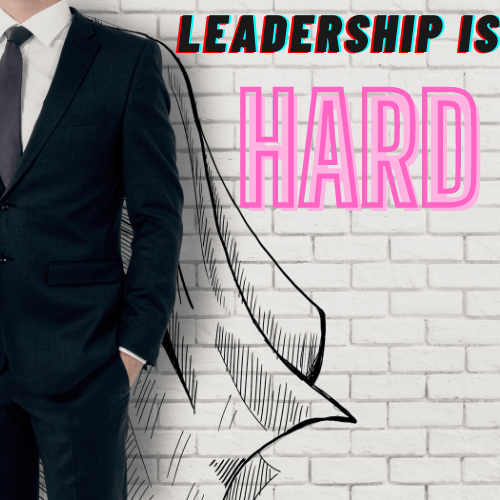
Leadership is my passion and beginning my journey on this adventure with you has been something I have wanted to do for many years. I did not start this trek earlier simply out of fear, quite frankly. Fear of being exposed, fear of not having all the experience I needed to begin, and fear of failure. After a lot of discussion with mentors and contemplation I have realized that there is no way to fail backwards, I can only fail forward. If my message does not resonate with anyone and I get no engagement with “Leadership Is Hard”, then I will have at least learned a lot about my ideas, my message, and how I can better communicate. Socrates said, “I know that I know nothing” and he was Socrates for crying out loud! I can admit that I know nothing, so I am hoping you will join with me as we all learn something together. Let’s work to be humble, work to be kind, and work to be a little better today than we were yesterday. Thank you for your time, and please keep an eye out for my upcoming podcast!
- Lindqvist, Erik. “Height and leadership.” Review of Economics and statistics 94.4 (2012): 1191-1196.
- Re, Daniel E., et al. “Facial cues to perceived height influence leadership choices in simulated war and peace contexts.” Evolutionary Psychology 11.1 (2013): 147470491301100109.
- Blaker, Nancy M., et al. “The height leadership advantage in men and women: Testing evolutionary psychology predictions about the perceptions of tall leaders.” Group Processes & Intergroup Relations 16.1 (2013): 17-27.
- Knight, Jennifer L., et al. “Out of role? Out of luck: The influence of race and leadership status on performance appraisals.” Journal of Leadership & Organizational Studies 9.3 (2003): 85-93.
- Van Dierendonck, Dirk. “Servant leadership: A review and synthesis.” Journal of management 37.4 (2011): 1228-1261.
 Leadership is Hard